
What is the Shutter Count, What Does It Mean and How Do You Even Check It?
You are browsing used gear and find a Canon 5D Mark III listed at a low price. The body looks clean in the photos and the seller describes it as a backup that rarely left the studio. Before buying, you ask for a recent JPEG and check the metadata.
It reads 287,000 actuations on a mechanism rated for 150,000. The body may look clean, but mechanically it is well past its design life. The number that told you this is the shutter count: a running total of every time the mechanical shutter has fired. It works like an odometer for a DSLR.
What the Shutter Count Measures
The shutter count is the total number of mechanical shutter actuations since the camera left the factory. Each time the shutter fires, a set of physical curtains travels across the sensor to control exposure. It is precision engineering driven by springs and electromagnets, and like any mechanical system it wears out over time.
When a shutter fails, it usually fails in one of these ways:
- Shutter bounce - The curtains lose their timing and one edge of the frame ends up darker than the rest.
- Tearing - The thin blades physically break, which can also damage the mirror box or sensor.
- "Err" on the display - The electromagnets fail to release and the camera refuses to take a photo.
A sensor itself can last effectively indefinitely, but the shutter is a consumable component.
What The Shutter Count Rating Means
The rated lifespan on a camera is a floor, not a ceiling. The number is based on stress testing. Think of it like the "Best Before" date on your milk. It does not mean the milk turns undrinkable precisely at midnight on the day stated, but that the manufacturer is no longer making promises about what happens after that.

So, it is important to have some kind of benchmark as a guide:
- Entry Level (Canon Rebels, Nikon D3xxx, Sony A6xxx) - These are usually rated for 100,000 actuations. They are meant for hobby work where one might shoot 5,000 photos a year.
- Mid-range/Semi-Pro (Nikon Z6 III, Canon R6 II, Sony A7 IV) - These usually land between 200,000 and 300,000. They are your workhorses and are a favorite among professional photographers.
- Flagship Professional (Nikon D6, Canon R1, Sony A1 II) - These are rated for between 400,000 and 500,000+ actuations. The shutters are made with reinforcements (typically Kevlar or carbon fiber) and are designed to survive 12-frame-per-second bursts for many years.
Hitting the rated count is not a guarantee of imminent failure. Entry-level bodies have been reported running past 300,000 actuations, and professional bodies have been known to fail well before their rating. The shutter count is a statistical expectation, not a hard limit.
Shutter Count as Negotiating Leverage
When you're buying used, the shutter count is your leverage in a negotiation. Cosmetic condition is a poor way to gauge usage. A professional wedding photographer might burn through 3,000 frames in a single weekend. Over three years, that camera has seen more wear than a hobbyist's gear would see in a decade, even if it was kept in a protective skin.
With that in mind, it is worth knowing the 70% rule:
- Under 20% of rating is considered "like new". In this case, expect to pay a premium.
- At 20% to 50%,you are in the "light to moderate use" territory. That is the sweet spot for value and negotiation.
- At 50% to 80%, we are talking "heavy use". At this point, you should be looking for a significant discount.
- If it is over 100%, the camera is on borrowed time. You should only buy this if the price is low enough that you can afford to pay for a $400 (on average) shutter replacement and still come out with an unscathed wallet.
Where Brands Hide Their Odometers
You might expect the shutter count to show up alongside Aperture or ISO in any metadata viewer. In practice, every manufacturer stores it differently.
Nikon
Nikon has been the most consistent on this over the years. Almost every Nikon DSLR and mirrorless body embeds the shutter count in the EXIF data of every JPEG under the "Image Number" or "Shutter Count" tag, which any metadata viewer will show.
Canon
With Canon, things get a bit difficult. Many of their bodies, especially the popular EOS R-series and older DSLRs, do not embed the true shutter count in the image files. You have to dive into the internal firmware to find it. This involves connecting the camera to a computer via a USB and using a third-party software like ShutterCounter (for Mac) or ESOInfo (for Windows).
Sony
Sony generally includes the count, but you have to go into the MakerNotes to find it with an EXIF tool. This area is proprietary and is generally where Sony stores its "secret" data. Many basic image viewers will not be able to see it. In this case, you have to use a more sophisticated metadata parser to find the "Image Count" tag.
FujiFilm and Panasonic
Fujifilm is the Wild West. Some models report it, and some don't. Some only report it in 1,000-click increments. You have to find out the specific model and what it calls for.
As for Panasonic, you often need to complete a secret handshake (a sequence of button presses when it starts up), which opens up a service menu on the back LCD. This is where you will find the number you're looking for.
Is the Number Becoming Less Meaningful?
Modern mirrorless cameras such as the Sony A9 III and Nikon Z8/Z9 support a fully electronic shutter, where the sensor reads out electronically and the mechanical curtains never move. Most shutter counts only track mechanical actuations, so a body that has shot heavily in electronic mode can show a low mechanical count.
That means a mirrorless body with a mechanical count of only a few thousand could still have captured hundreds of thousands of frames electronically. The mechanical shutter might be pristine, but other wear-prone parts (IBIS system, card slots, buttons, dials) will have seen all of that use. When buying a mirrorless camera used, ask about electronic shutter usage in addition to the mechanical count.
What Else Wears Out?
A high shutter count is often a clue as to the environmental wear of the camera. A camera with 300,000 clicks has been exposed to the elements 300,000 times. Even if the shutter is still working, it is worth considering the other things that tend to fail.
- Sensor Dust & Degradation - High-mileage cameras often have more pixels that stay lit (hot pixels) due to sensor age and heat.
- The lens mount - Frequently swapping lenses can wear down the metal flange, leading to jiggling or loose connections between the lens and the body.
- The IBIS system - In mirrorless cameras, the sensor is "floating" on magnets. Over hundreds of thousands of shots, this stabilization mechanism can become less effective.
- The battery door and dials - Professionals usually swap the battery hundreds of times and turn the command dials thousands of times. Check for "mushy" buttons or dials that skip values when you engage.
How to Check the Shutter Count in 30 Seconds
Instead of relying on the file name, which resets every time you format a card or hit 10,000, try following these steps to find out the truth:
- Take a fresh photo - Set the camera to JPEG (Small/Basic is fine). Use the mechanical shutter mode.
- Transfer the photo - Do not edit it or run it through Lightroom. Do not "save for web" either. This will strip the metadata you need.
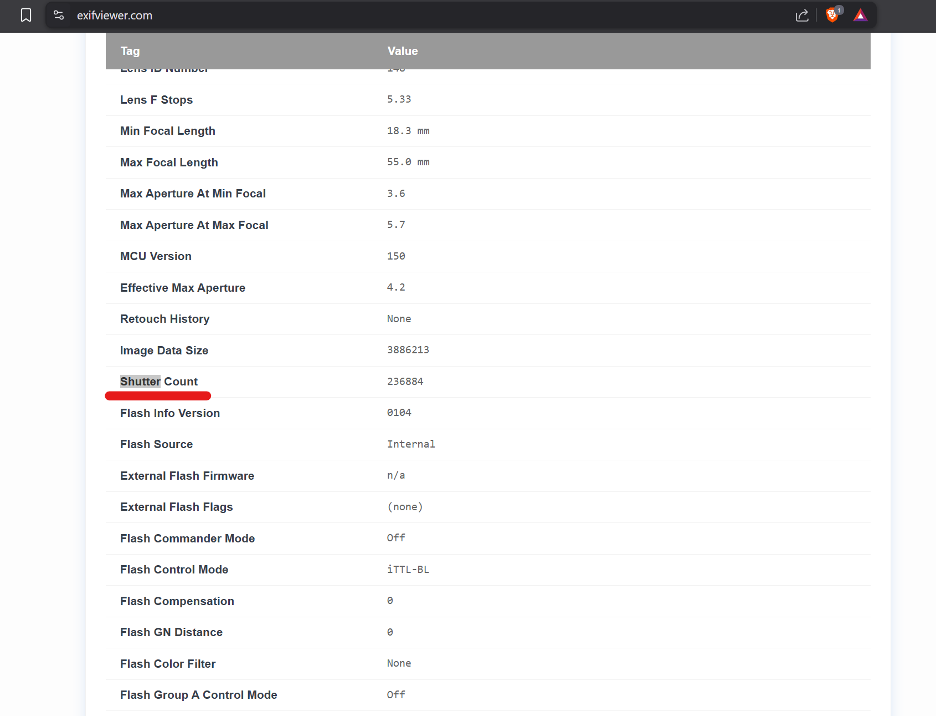
- Use an EXIF parser - Upload the RAW file to a tool like EXIF Viewer
- Look for the metadata - If the shutter count does not show up in the standard list, look for the manufacturer-specific section.
- Compare to benchmarks - Search for the camera's mode to find out what it is rated for and see where you fall in that spectrum.
Shutter Count Matters, But So Does the Price
The shutter count is a useful data point when evaluating a used camera, but it is only one factor. If a body is near or past its rated limit, authorized service centers like Canon Professional Services and Nikon Professional Services can replace the shutter assembly, typically in the $250-$500 range. That cost can be factored into the negotiation rather than treated as a dealbreaker.